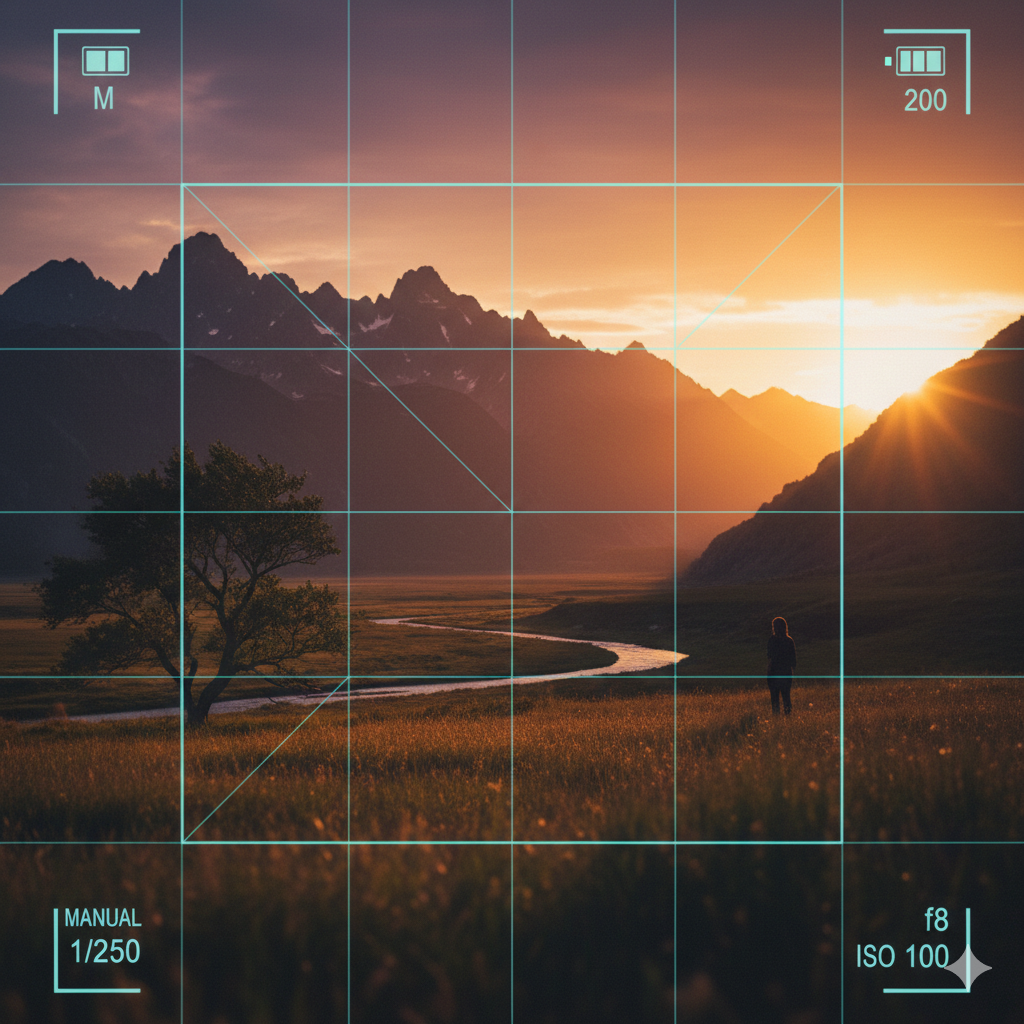
What Composition Actually Is
Composition is the decision of what to include in a frame, where to place it, and how elements relate to each other. It's not a technical setting — it's a way of seeing. Two photographers standing in the same spot with identical cameras will produce completely different images based solely on how they compose the shot.
The good news: composition can be learned. The rules aren't arbitrary; they're based on how human eyes naturally scan an image. Learning them gives you a vocabulary. Breaking them deliberately — once you understand them — gives you a style.
Rule of Thirds
Divide your frame into a 3×3 grid (most cameras can overlay this in the viewfinder). The rule of thirds says your subject should sit on one of the four intersections of those grid lines, not dead-centre. Horizons should follow the top or bottom third, not cut the image exactly in half.
Why does this work? A centred subject feels static and confrontational. An off-centre subject creates visual tension — the eye has somewhere to travel. The empty space on one side feels intentional rather than empty.
The exception: deliberate symmetry. Reflections, architectural shots, and portraits where eye contact and power are the message often work best dead-centre. The rule of thirds is the default; symmetry is the override.
Leading Lines
Roads, rivers, fences, staircases, shadows — any line that draws the eye into the frame and towards the subject is a leading line. They're one of the most powerful compositional tools available because they work unconsciously. The viewer doesn't notice the road; they just feel pulled towards the mountain at the end of it.
Leading lines work best when they converge towards the subject or towards a point of interest. Diagonal lines feel more dynamic than horizontal ones. Lines that lead off the frame without resolving create unease — sometimes intentionally, sometimes not.
Framing Within the Frame
Use elements in the scene to create a natural frame around your subject: an archway, overhanging branches, a window, the gap between two buildings. This does two things simultaneously — it directs the eye exactly where you want it, and it adds depth by establishing foreground, middle ground, and background.
The frame within a frame doesn't need to be in sharp focus. Often a slightly soft foreground frame with a sharp subject behind it feels more natural and cinematic than everything at the same focus distance.
Foreground Interest
Particularly important in landscape photography: a strong foreground transforms a flat image into one with depth and dimension. Instead of photographing a mountain, walk closer to the wildflowers in front of it and use them as foreground interest. The image now has an entry point, a journey through the frame, and a destination.
This is also why wide-angle lenses are popular for landscapes — they exaggerate the distance between foreground and background, amplifying the sense of depth.
Negative Space
Negative space is the empty area around a subject. Used intentionally, it creates a sense of isolation, scale, or calm. A single figure in a vast desert, a bird against a clean sky, a lone tree in a snow field — the emptiness is doing as much work as the subject.
Beginners often fill the frame because empty space feels like wasted space. It isn't. Resist the urge. Some of the most powerful images are mostly empty.
Simplify, Simplify, Simplify
Before you press the shutter, ask: what is this photograph about? Then look at the edges of the frame and eliminate everything that doesn't answer that question. Distracting elements at the edge of a frame — a lamppost growing out of someone's head, a bright patch of sky in the corner pulling the eye away — can be fixed by moving slightly, changing focal length, or adjusting your position.
The discipline of asking "do I need this in the frame?" before every shot is worth a thousand hours of post-processing.
When to Break the Rules
Every rule here describes what tends to work, not what must be done. A centred subject can be commanding. A cluttered frame can feel alive. Lines leading nowhere can feel melancholy and poetic. The rules become useful only after you've internalised them — because then breaking them is a choice, not an accident.
Shoot a hundred frames following the rules. Then shoot ten breaking each one deliberately. Compare them. That's how composition becomes intuitive.