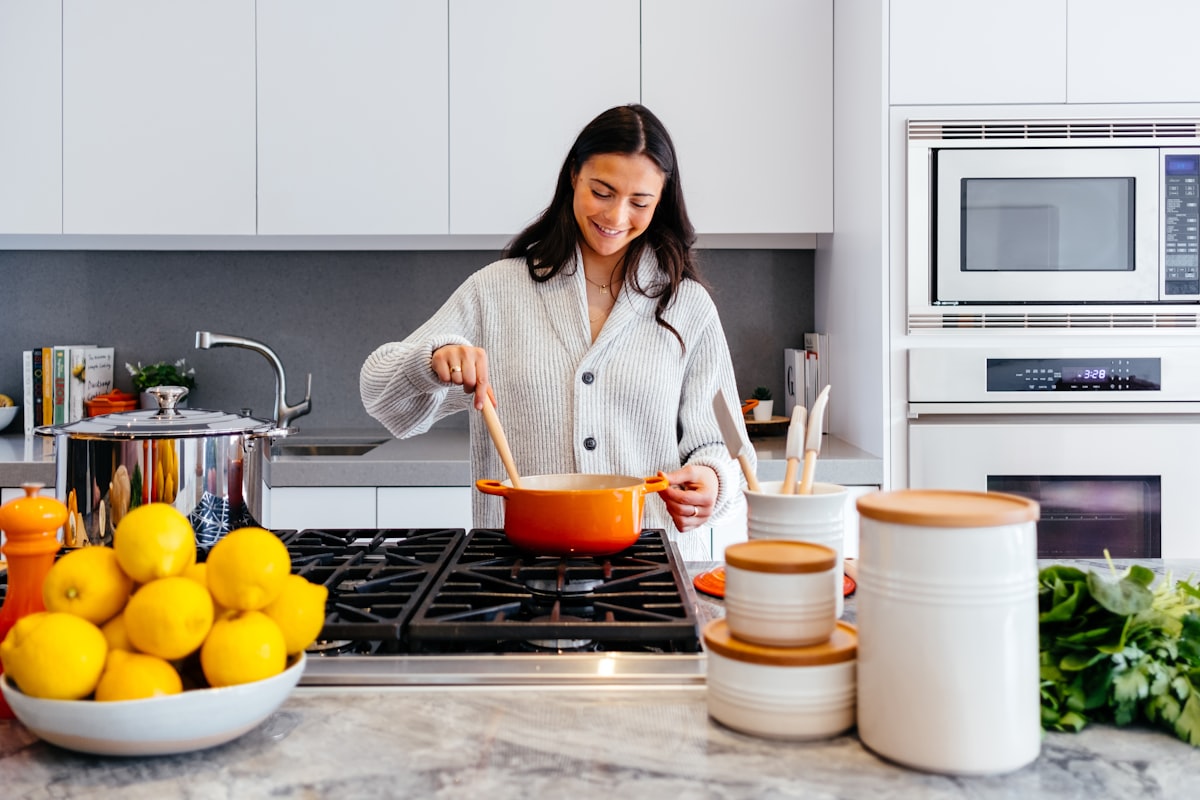
There is a special kind of optimism that happens when you book an Airbnb with a kitchen.
You look at the photos and think, Perfect. I can cook here.
There is a beautiful countertop. A stove. Maybe an oven. A coffee machine. Six matching glasses. Everything looks like you are about to spend the next month cooking healthy meals and saving money.
Then you arrive.
The stove has two settings: barely warm and nuclear.
The frying pan looks like it has survived three wars.
There are four forks, seven wine glasses and somehow no decent knife.
The cutting board is approximately the size of a postcard.
And the one kitchen knife provided by the host couldn't cut through a ripe banana.
Welcome to cooking in an Airbnb.
After living and traveling in temporary apartments, I've learned that cooking while traveling is actually pretty easy.
The difficult part is cooking in a kitchen you didn't choose.
So I've developed a simple rule:
Don't try to recreate your kitchen at home. Learn how to work with whatever ridiculous kitchen you have been given.
(If you want actual recipes built for exactly this situation, I put together 10 easy digital nomad recipes that assume you have almost nothing to work with.)
The Airbnb Kitchen Lottery
Every Airbnb kitchen is a gamble.
Sometimes you get lucky.
You open the cabinets and find a decent frying pan, a proper knife, a cutting board, a large pot, storage containers and enough utensils to cook for an actual family.
Other times, you open the cabinet and find one tiny saucepan, two spoons and something that might have been a spatula in 2007.
The first thing I do when I arrive is inspect the kitchen.
Not because I'm obsessive.
Because I don't want to discover at 8 p.m. that there is no frying pan after I've already bought chicken.
I check:
- What kind of stove is there?
- Is there an oven?
- Is there a microwave?
- Is there a decent frying pan?
- Is there a pot?
- Is there a usable knife?
- Is there a cutting board?
- Is there enough refrigerator space?
- Is there salt?
- Is there cooking oil?
- Are there basic plates, glasses and utensils?
This takes about five minutes.
It can save you from buying groceries for a meal you can't actually cook.
The Five Things That Matter Most
You don't need a fully equipped kitchen.
You need five things.
A decent frying pan.
This is probably the most important piece of equipment in an Airbnb kitchen. With a good pan, you can cook eggs, chicken, steak, vegetables, ground meat, tortillas and a ridiculous number of other things.
A decent knife.
Not necessarily a professional chef's knife. Just something that actually cuts.
A cutting board.
If the only option is cutting everything on a tiny plate, cooking becomes annoying very quickly.
A pot.
Useful for pasta, rice, soup, potatoes and anything else that requires boiling.
A spatula or pair of tongs.
Because trying to flip a steak with a spoon is not a cooking technique. It's a cry for help.
Everything else is optional.
Don't Go Grocery Shopping Like You're Opening a Restaurant
This is one of the biggest mistakes people make when staying in an Airbnb.
You arrive. You go to the supermarket. You get excited.
You buy eggs, chicken, steak, vegetables, fruit, cheese, pasta, rice, sauces, spices, snacks, yogurt, milk and approximately seventeen other things.
Three days later you realize you're leaving.
Now you're standing in front of the refrigerator trying to figure out how to use half a bottle of sauce, six eggs, two onions and enough vegetables to feed a small village.
When you're traveling, buy for the amount of time you're actually staying.
If I'm staying somewhere for a week, I don't need a month's worth of groceries.
I usually buy a few basic ingredients that can be used in several meals.
Eggs are one of the easiest examples.
Breakfast? Eggs. Quick dinner? Eggs and vegetables. Nothing else in the refrigerator? Omelette.
Chicken works the same way.
Cook it with vegetables one night. Put it in a wrap the next day. Throw it into pasta or rice after that.
You don't need complicated meal planning. You need ingredients that can survive multiple meals.
The One Pan Rule
I have a simple philosophy when cooking in temporary apartments:
The fewer dishes I have to wash, the better.
One-pan meals are almost perfect for traveling.
Chicken and vegetables. Steak and eggs. Ground beef with vegetables. Shrimp and rice. Fried rice. Pasta with meat and vegetables.
There are hundreds of combinations.
You don't need five pans, three pots and a kitchen full of equipment to make good food.
You need one decent pan and a little imagination.
And honestly, after spending the entire day working, I don't want to finish dinner and discover that I've created a mountain of dishes.
I'm traveling. I'm not opening a restaurant.
Airbnb Knives Are a Different Species
I don't know who buys kitchen knives for most Airbnb apartments, but I have questions.
Some of them are so dull that cutting a tomato becomes a negotiation.
You press down. Nothing happens. You press harder. Still nothing.
Eventually the tomato explodes and somehow you're holding the knife like you're defusing a bomb.
You don't need an expensive knife for temporary living. You just need one that works.
If you're staying somewhere for several weeks or months, buying an inexpensive local kitchen knife can be completely worth it.
If you're only staying for a few days, just work with what you have.
There is no reason to turn a three-night Airbnb stay into a kitchen equipment acquisition project.
Learn to Cook With Local Ingredients
One of the best things about cooking while traveling is that you don't have to eat exactly the way you eat at home.
Actually, you probably shouldn't.
You're somewhere different. Use what's available.
Go to the local supermarket or market. Look at what people actually eat there.
Buy local vegetables, fruit, meat, cheese, bread, tortillas, spices or whatever happens to be good and inexpensive.
You don't need to find the exact brand of something you used to buy back home.
That's one of the advantages of traveling. You can make simple food and still experience where you are.
Some of my favorite meals while traveling have been completely improvised.
I walk into a supermarket without a plan, see something that looks good, buy it, and figure out what to do with it later.
Sometimes it works beautifully. Sometimes dinner becomes an experiment that should never be repeated.
That's part of it.
What If the Kitchen Has Almost Nothing?
This happens.
Maybe there is no oven. Fine. Use the stove.
No microwave? You probably won't miss it.
Terrible cookware? Keep the meal simple.
Only one pan? Congratulations. You have everything you need.
You can make an enormous number of meals with eggs, meat, vegetables, pasta, rice, tortillas and a few basic seasonings.
The trick is not having more equipment.
The trick is reducing the number of things you are trying to do.
When the kitchen sucks, simplify. Don't fight it.
Cooking Isn't Always Worth It
This might be the most important part.
Cooking is not automatically better just because you have a kitchen.
If I'm staying somewhere for two nights and the local food is cheap, good and everywhere, I'm probably going to eat out.
If I've been working all day and I'm exhausted, I'm not going to prove something to myself by cooking an elaborate dinner.
And if I'm staying somewhere for a month, cooking becomes much more attractive.
You learn the supermarket. You find your favorite butcher. You figure out where to buy good vegetables. You understand the kitchen. You develop a routine.
That's when having an Airbnb kitchen really starts paying off.
The goal isn't to cook every meal. The goal is to have the option.
The Night Before You Leave
There is one final rule that saves a surprising amount of money.
Empty the refrigerator.
Don't buy groceries like you're staying forever when you know you're leaving tomorrow.
The last couple of days are perfect for cleaning out whatever remains.
Eggs. Vegetables. Leftover meat. Cheese. Rice. Pasta. Whatever is still sitting there.
Throw everything together and make something.
Sometimes the best meal of the week is the completely random one you make because you're leaving tomorrow and refuse to throw food away.
And if it's terrible? Well, you're leaving anyway. Perfect.
My Airbnb Kitchen Survival Rules
After enough temporary apartments, I've settled on a few rules.
- Inspect the kitchen before buying groceries.
- Buy fewer ingredients, not more.
- Choose ingredients that can be used in several meals.
- One pan is usually enough.
- Don't waste money buying a complete kitchen for a two-week stay.
- Use local ingredients instead of trying to recreate home.
- Keep meals simple when the kitchen is bad.
- Don't cook just because you can.
- Use everything in the refrigerator before you leave.
And most importantly: don't expect the kitchen to be perfect.
That's the whole point.
You're traveling. You're living temporarily. Things are going to be different.
Sometimes the pan will be terrible. Sometimes the knife will be useless. Sometimes the refrigerator will be the size of a shoebox.
You adapt.
That's actually one of the things I like about cooking while traveling.
You walk into a completely unfamiliar kitchen, look around at what you've got, and figure out dinner.
It isn't about having the perfect kitchen.
It's about making something good with whatever is in front of you.
And if everything else fails? There's probably a restaurant downstairs.